
VON STERNBERG’S LAST INTERVIEW
by Philip Jenkinson
In May of 1968 I visited Hollywood, and through a very good friend, director and move historian David Bradley, was « introduced’ to von Sternberg. In his final years he had become very wary of people, rarely going out, and even more rarely having guests. His fortress-like house even had a moat round it. So being « introduced » to von Sternberg was being allowed the privilege to talk to him on the telephone. David, my friend, had known him for some years, and called him ‘Joe,’ but getting to know him that well would obviously take a lot longer than the three weeks I was in Hollywood. So I plunged in at the deep end I explained I had a small camera crew at my disposal and would he submit to a short interview, wherever and whenever he chose? Impossible! Might he then consider a meeting at which I just taped our conversation? No, tapes could be edited, and people made to appear to say things they did not mean. Then how might we converse? It was my host in Hollywood, producer Arthur Jacobs, who came up with the answer. « Ask him if he’ll have a telephone conversation with you, and I’ll get one of the stenographers from Fox to listen on the extension, and take it all down verbatim. »
I asked von Sternberg if I could talk with him on the phone some evening when he had a little time, and did he mind if I made some notes?
« I’ll talk with you, and you can make notes, but if you think I’m going to say anything more than I’ve already said in my book Fun in a Chinese Laundry, you’re mistaken. »
Two evenings later, I phoned him for the house of Arthur Jacobs, with the Fox secretary on the extension line. This is a verbatim account of the conversation that took place:
French version soon
Philip Jenkinson: Thank you for speaking with me, Mr. von Sternberg.
Von Sternberg: That’s alright, but I haven’t much time, you know.
PJ: No, I realized that and I promise to try to be brief. If I ask you anything you think is nonproductive, or which you don’t care to answer, please just say so, and we’ll go on to something else.
VS: Very well, though I doubt, if you don’t mind my saving so, whether you’ll ask me anything I haven’t already been asked a hundred times or more.
PJ: I don’t want to go too far back–not as far back as Docks of New York and Underworld…
VS: That’s a relief.
PJ: … but I would like to concentrate mainly on your Paramount period from Morocco through to The Devil is a Woman.
VS: What about my best picture?
PJ: Which is that?
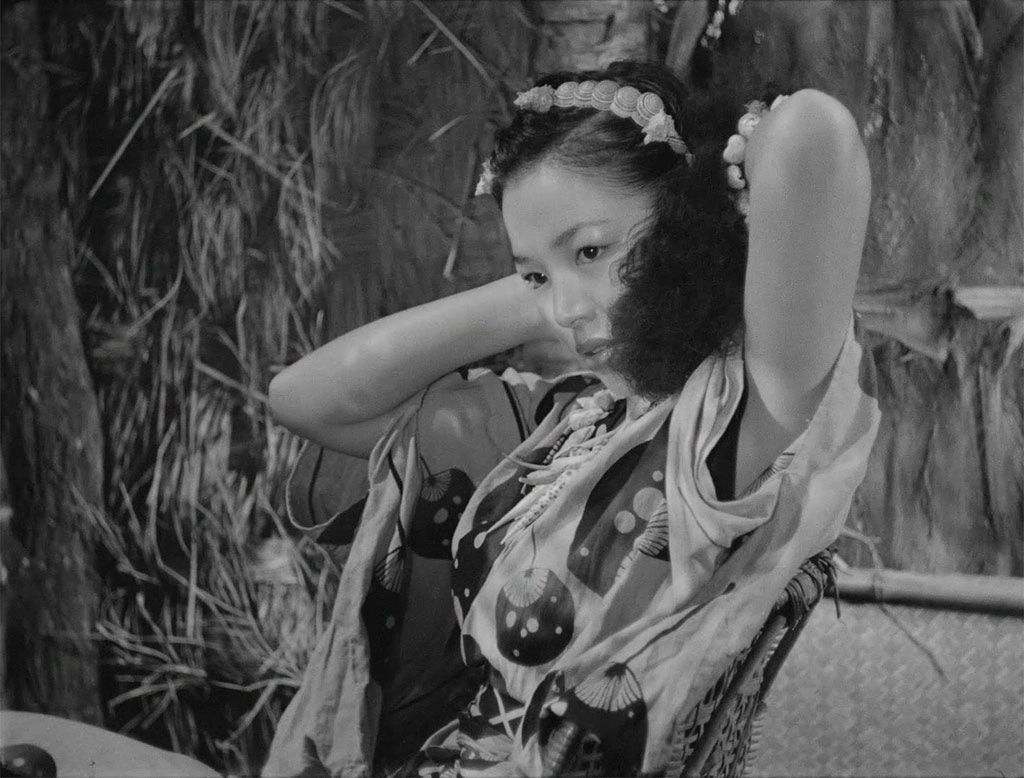
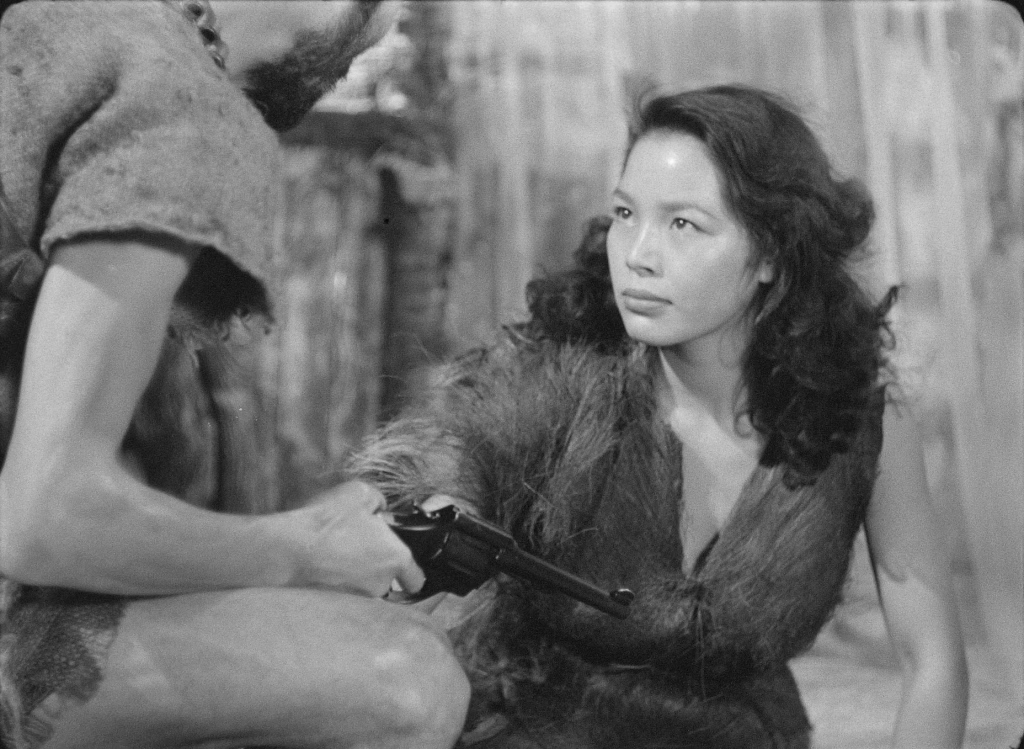
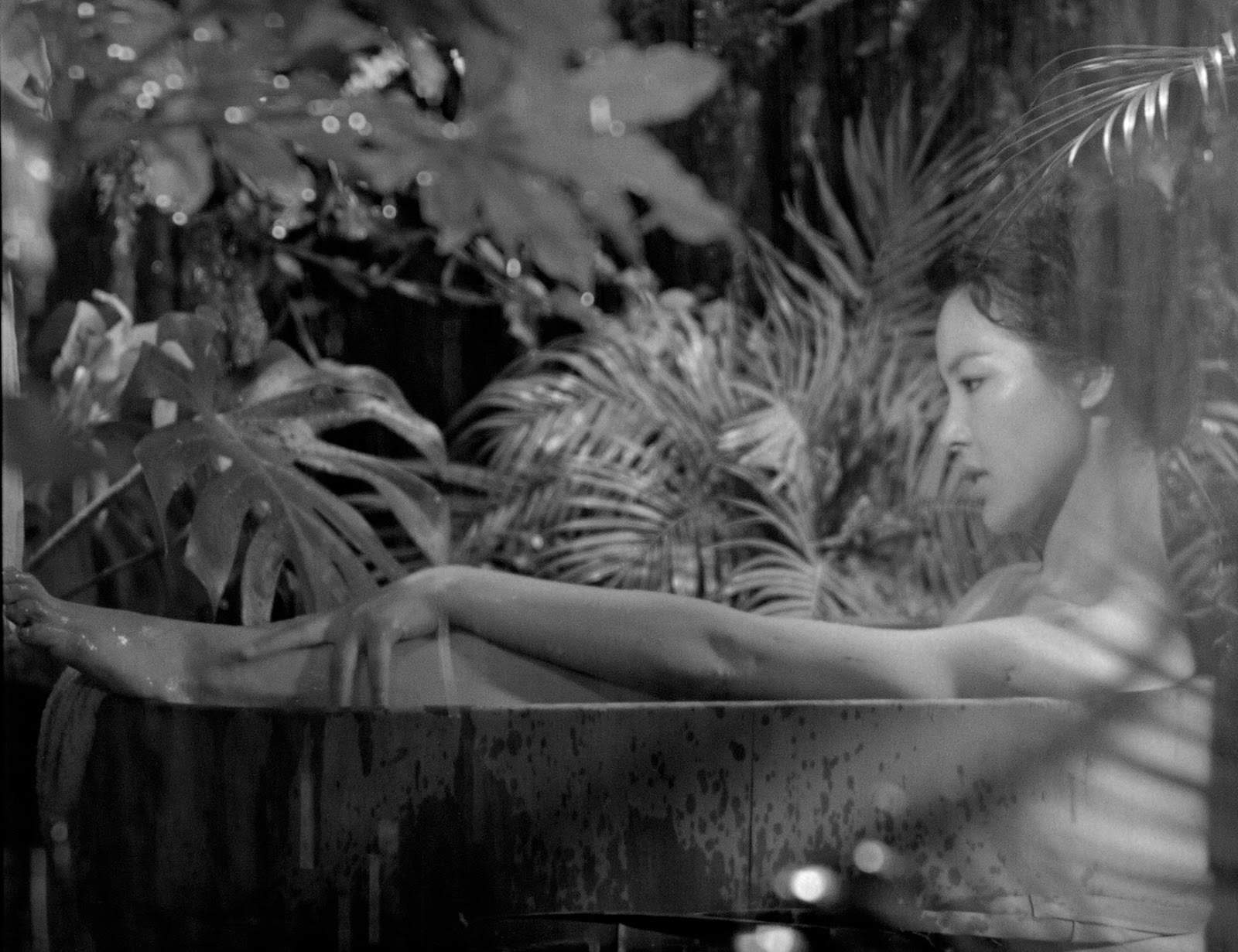
VS: The Saga of Anatahan.
PJ: I’m afraid I’ve only seen a very poor, badly cut 16mm print of it, so I didn’t feel qualified to ask about it.
VS: A pity. You must see a good print of it. There are plenty around.
PJ: It’s something I’ll look forward to, though it’s very different from your other films, wouldn’t you say?
VS: I use cameras, lights, people talking, doing things, how is that different?
PJ: The whole style, the story and the almost sort of documentary approach.
VS: I never really know what people mean when they talk about the documentary as opposed to the fiction, the make-believe. All cinema is fiction because it has been contrived, and if it has been contrived, then it can’t be natural. You see something with your eyes; that is natural. That is real. But a camera records only artifice. Selection, er–organization and choice has taken place; it’s no longer…er…
PJ: Spontaneous?
VS: No, that’s not the world. I have often used what you call spontaneity in my pictures. As soon as you look through the viewfinder and say « Move a little this way, move a little that way… » that’s not spontaneous; you’re organizing, and in that way it becomes a fiction.
PJ: You used the word artifice, and that’s the very word I have here in my notes to describe your famous style. Can you tell me a little about it?
VS: About what?
PJ: Your famous picture quality, lighting effects,…er, compositions. They were a kind of trade mark.
VS: I’m sorry to hear you say that; it sounds as if I’d hit on some kind of formula.
PJ: No, no, I didn’t mean that at all. But you must admit there was a very pronounced style of shooting, of lighting, of picture composition that ran through nearly all your films.
VS: You’re talking about depth. I don’t mean intellectual depth, there was nothing intellectual about my pictures. But I used foregrounds, middlegrounds and backgrounds. I built depth into my sets, I used depth in my lighting–you know, shadows, pools of light, darkness, then maybe something glowing away at the back. And I tried to use depth in my grouping.
PJ: Is that why you often shot through foregrounds–er, nets, ropes, veils, windows, gauzes….
VS: Are you saying did I use filters, gauzes, vignettes and so on?
PJ: Well, some of your close-ups look very heavily filtered.
VS: Name one.
PJ: The marriage sequence in The Scarlet Empress. Those huge close-ups of Miss Dietrich’s face.
VS: You know, there used to be a joke about those big misty close-up shots. Word got around that some cameraman had obtained wonderful results by rubbing soap on his lens. We used to call them ‘soap’ shots. But if you’re saying I relied on filters and gauzes and all those other things we were supposed to have used, then you’d be wrong. There was depth even in those close-ups, and I could get exactly the effect I wanted by moving a light maybe three inches to the left, or changing the focus by a mere touch to the lens.
PJ: Didn’t this mean terribly slow shooting schedules. I mean, didn’t each set-up take ages and ages?
VS: To begin with, I might take an hour, two or occasionally three to get something I wanted, but then it wouldn’t be discarded. I might use that set-up many times during one scene. No, I wouldn’t say I was slow.
PJ: But didn’t the actors get terribly bored and pent-up while you did all this preliminary setting-up?
VS: All the actors got bored. Boredom was a part of film-making. I don’t think my actors were more or less bored than anyone else’s.
PJ: Do you think you were fair to your actors?
VS: Why do you ask that?
PJ: Clive Brook told me that most of the actors on the set were scared stiff of you.
VS: When did he tell you that?
PJ: Recently when I had him around, and we showed Shanghai Express.
VS: And what exactly did he say?
PJ: He said that you made them all talk in a kind of rhythm because you were supposed to be on a train. He said you put a metronome on the set and made them keep time with it.
VS: Mr. Brook is a very good actor but you know, if actors don’t understand something they get very suspicious and frightened.
PJ: Surely that’s a bad thing?
VS: Mr. Jenkinson, if I had stopped to explain my every move to the actors we would never have finished a single picture. I found it better to tell them as little as possible, keep them in a kind of suspense. This way, when their time came before the camera, they were very eager to try different methods, to take different approaches. If I had stopped each time to tell them exactly what was going on, the mystery would have disappeared.
PJ: You mean you wanted to explore their uncertainty?
VS: No, I wanted always a slight element of surprise, as if they’d only just thought of their next line, or their next move.
PJ: In your book you particularly single out Charles Laughton and Emil Jannings as being difficult, if not impossible, to direct.
VS: Mr. Jannings was endlessly inquisitive about what « I » was doing. I merely tried to point put to him he’d spend his time better if he concentrated on what « he » was doing. I think Mr. Laughton at heart wanted to be a director.
PJ: Yes he did. He made Night of the Hunter, a very unusual movie.
VS: I believe so. But I explain the difficulties with Mr. Laughton in my book, so I don’t believe there is much point in reiterating them here.
PJ: Was Miss Deitrich ever difficult to direct?
VS: When she was curious about something, she might say, « Why am I doing this, or why do I say that? » That could sometimes be tiresome.
PJ: But surely it’s natural for an actor to be inquisitive?
VS: It is quite impossible for a director to become an actor’s Svengali. You might just as well work with puppets. There seems to be some notion that I acted as Miss Dietrich’s Svengali. This is totally untrue. When we made successful scenes or pictures together it was because there was complete understanding. If we failed, and that’s up to the audience and critics to judge, then it would only be because somewhere there had been a lack of understanding in what we were trying to do. Do I make myself clear?
PJ: But one certainly gets the impression from watching her many different facets on the screen and from things you say in your book, that to an extent you were her mentor, and she a very willing pupil.
VS: I certainly wouldn’t say willing, nor would I approve the word mentor. She was responsive to suggestion and on the whole, quite cooperative. I don’t think those are requirements a director is unreasonable to expect.
PJ: Then what about the Paramount front office? Didn’t they ever question some of your so-called extravagances? I mean, what, for instance, did they think when you ordered those massive carved seats for the council chamber in Scarlet Empress?
VS: For a start, the crowd scenes in Empress were stock shots several of the exteriors were models, and as far as I can remember, there were only four main interiors. You mentioned the wedding sequence, I think. Well, that was just a great number of candles, some incense and maybe two dozen extras. I don’t think you could call that extravagant.
PJ: But those carvings and weird murals must have cost a fortune.
VS: I noticed them being broken up in the back lot a couple of weeks after we’d finished shooting. They couldn’t have cost that much, because it was a standard joke that Paramount wasted nothing.
PJ: How much of the design of your films during the period was under your own supervision?
VS: That depend entirely on what the scene was. If it was a train and a country station as in Devil is a Woman, I had little choice in the matter. But if it was the carnival, say, at the beginning of the picture, I told them exactly what I wanted.
PJ: And what was that?
VS: As many ballons and streamers as they could lay their hands on.
PJ: The two forests; the one in Scarlet Empress where she runs through those twisted trees, and the duel in the rain in The Devil is a Woman; they were interiors, weren’t they?
VS: Yes, and on a very small stage as I recall. I had to give the impression of space by making the trees very small and shooting them over and over again, each time from a different angle, to make the forest seem large. It wasn’t difficult but I would have preferred more space.
PJ: I was going to ask you; were these hindrances a challenge or did they inhibit you?
VS: I was like any worksman with his tools; I made as much use as I could with what I was given. It’s the same with actors; they ranged from brilliant to totally inadequate. It was my job to make it impossible for the audience to detect the difference. Concealment is a great weapon if used correctly.
PJ: Is that one of the reasons you often obscure some of the action with the foreground, or shoot through nets, like you did in Macao?
VS: I thought we were only discussing my Paramount pictures.
PJ: I just mentioned Macao as an example.
VS: As I recall, six different directors worked on that picture.
PJ: Was the abandoning of I, Claudius a great disappointment to you?
VS: I thought we were only going to discuss my work at Paramount.
PJ: I’m sorry.
VS: The reasons for the collapse of that project are detailed in my book, for those who are interested. I think my strongest feeling was that of relief.
PJ: Are you surprised or even irritated by the terrific amount of interest that is currently being taken in your films.
VS: Do you mean, am I flattered?
PJ: No; having read your book your strike me as a man not kindly disposed to flattery or adulation.
VS: People must make of my work what they can. One year this is in fashion, the next year it is something else. Today the vogue is for distraction. I am not responsible for what people may think, or write or say about my work.
PJ: But you were the instigator, the creator,
VS: And so is the man who invents the electric toothbrush.
PJ: Are you then saying there is nothing to be learned, nothing of abiding value in your work?
VS: I am saying nothing of the sort. I am merely pointing out that–let us say evaluation is somebody’s else’s job, not mine.
PJ: You sound, if I may say so, almost indifferent to what people think.
VS: Let me tell you, Mr. Jenkinson, anyone who thinks making pictures is an easy business must be either an idiot or a genius. In my time I have met many idiots but very few geniuses.
PJ: Have you any plans to make any more films, any projects underway?
VS: All people discuss today is the ‘art’ of the film. Do you know what the art of the film is? I’m not sure I am interested enough to find out. I know that making a film creates hundreds of problems, each one of which has somehow to be solved. From what I read, and see and hear. I doubt if today’s problems are worth solving. Today’s director, it seems to me, has to have the cunning of a card cheat and the sophistry of a gigolo. I have no desire to be either, and anyway, I am too old. And now, Mr. Jenkinson, it is getting late and I think we should finish. Have you said all you wanted to say?
PJ: Well, of course, I had more questions, but we’ve already spoken a long time and I certainly don’t want to outstay my welcome. Perhaps, maybe, we can talk again soon.
VS: I will be talking to David in the next few days. Perhaps we can fix another time.
PJ: Thank you for talking to me today. It was very kind of you. I hope I didn’t bore you by asking the usual questions.
VS: People are usually inquisitive about the same things, but I have enjoyed it. Good bye.
PJ: Good bye.
Von Sternberg caught a cold during the next few days, and didn’t call my friend. I had to return to England, and next time I went to America, two years later, von Sternberg was dead.
•
THE LAST COMMAND
by Josef von Sternberg
1928